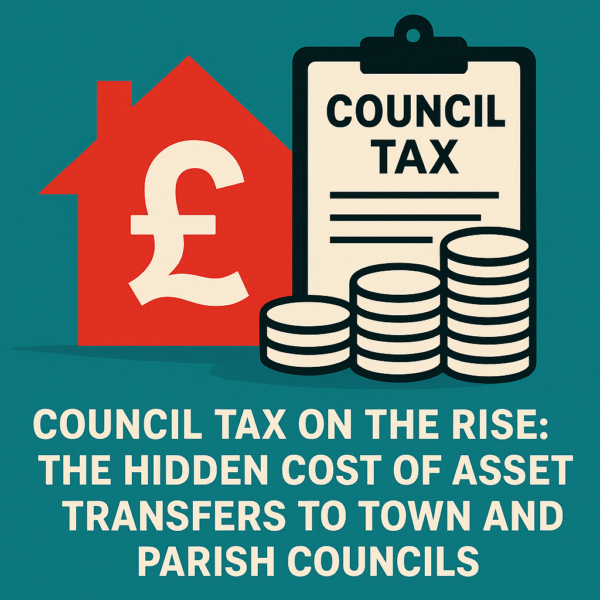
As local government reorganisation unfolds and District Councils move to transfer assets to Town and Parish Councils, residents face a growing but often overlooked risk: rising council tax bills. These increases won’t come from central government or even your County Council, but from the smallest tier of local government – your Town or Parish Council.
While these councils are typically associated with hanging baskets, local events, and noticeboards, they’re now being asked to take on a lot more. And the cost of that will fall directly on local taxpayers.
What’s Changing
In areas where District Councils are being abolished or slimmed down ahead of unitary reform, they are seeking to divest themselves of parks, public toilets, community halls, street lighting, and other local assets. Their solution? Offer them to Town and Parish Councils – often with little or no funding attached.
These councils have no access to business rates or central government funding. Their only means of raising revenue is through the local precept – the portion of your council tax bill that goes directly to them.
Why Residents Should Be Concerned
- No Cap on Increases Unlike District and County Councils, Town and Parish Councils are not subject to council tax referendum limits. That means they can raise their precept significantly without a vote or consultation. In some areas, this has led to double-digit percentage rises in a single year.
- Poor Transparency Many residents don’t even realise their local precept has increased – until they examine their council tax bill line by line. The headlines often focus on County Council rises, while the local tier quietly ramps up charges to fund new responsibilities.
- Paying More for Less Asset transfers are rarely matched with full funding. That means Town and Parish Councils either cut services elsewhere or raise the precept to cope. Residents end up paying more, just to maintain the same standard of service they had before.
- Inequality Between Areas Not all Town and Parish Councils are equal. Some have healthy reserves and skilled staff. Others don’t. This leads to a postcode lottery, where residents in one parish pay more for basic services, while those in a neighbouring town pay less for better provision – simply because of how prepared their council was to take on new assets.
- No Say in the Matter Residents rarely get a vote on whether assets should be transferred or what their parish should take on. Decisions are made by a small number of councillors, often under pressure to accept assets quickly before a district council is dissolved or its budget disappears.
What Can Be Done?
- Residents should scrutinise council tax bills and ask their local council to justify any precept increases.
- Town and Parish Councils must communicate clearly about what is being taken on and why, and be honest about the financial impact.
- Transfers should come with proper funding or not happen at all.
The shift of assets from District to Town and Parish Councils may look like “localism” in action, but without transparency, consultation, and funding, it’s simply cost-shifting. And the taxpayer ends up footing the bill.